
Professional All-in-One Solution
Letter Bending Machine
Kegema MLB150
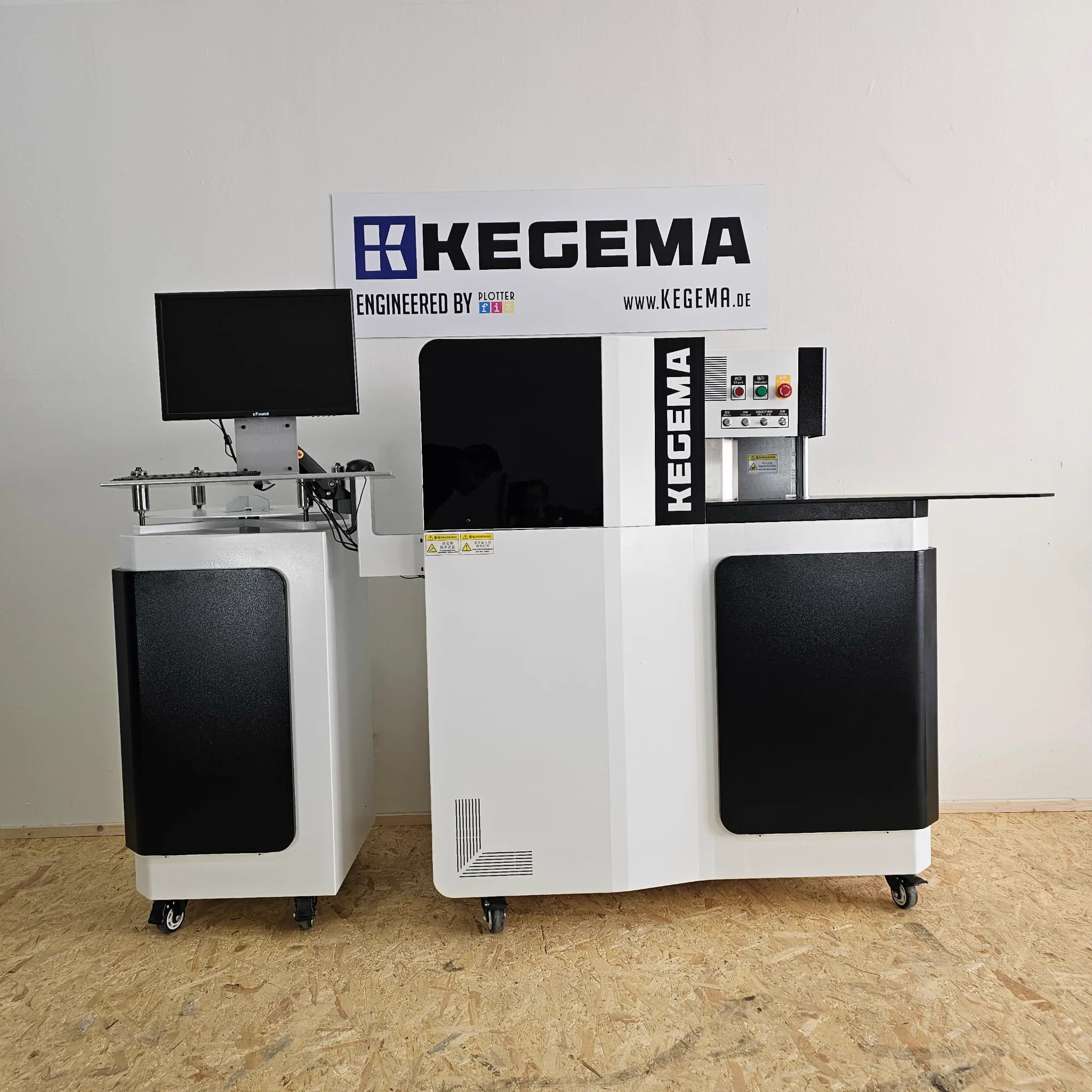
The MLB150 automates the production of channel letters at an industrial level. It combines feeding, notching, milling and bending in a single, high-precision system – ideal for modern sign and illuminated advertising companies.
- Material Versatility: Flat aluminium, stainless steel, galvanised sheet & aluminium coil
- Precision: Feed accuracy of ±0.1 mm for perfect results
- All-in-One: Integrated notching, milling and fully automatic bending
- Software Included: Intuitive operation via AutoDrive / CBS4
Maximum Workflow for Illuminated Signage
Technology that pays off: reduce manual work and increase your output.
Maximum Flexibility
Whether 0.3 mm stainless steel or 1.5 mm aluminium profiles (including foam / channelume). The machine adapts seamlessly to your material thicknesses.
Smart Software
The integrated Auto Bending System reads common formats such as AI, DXF or PLT directly and automatically generates the perfect bending path.
German Support
As with all our machines, our own technical team provides full support for installation, training and maintenance.
Which materials does the Kegema MLB150 process?
All specifications and capacities at a glance.
The Kegema MLB150 processes aluminium profile, flat aluminium, stainless steel and galvanised sheet at band widths from 30 to 150 mm. It bends aluminium from 0.6 to 1.5 mm and stainless steel from 0.3 to 0.8 mm. Feeding accuracy is ± 0.1 mm with a minimum bending radius above 10 mm.
| Model | Kegema MLB150 |
|---|---|
| Materials processed | Flat aluminium, aluminium profile (incl. foam / channelume), aluminium edging, stainless steel, galvanised sheet |
| Material thickness – aluminium profile | 0.6 – 1.5 mm |
| Material thickness – stainless steel | 0.3 – 0.8 mm |
| Material thickness – galvanised sheet | 0.4 – 1.0 mm |
| Material width (total) | 30 – 150 mm |
| Common material widths | 60 / 70 / 80 / 90 / 100 / 110 mm, custom sizes available |
| Material working height | 20 – 150 mm |
| Feeding accuracy | ± 0.1 mm |
| Minimum bending radius | > 10 mm |
| Supported formats | AI / PLT / DXF / NC |
| Control boards | ADTECH / Leetro (4-axis) |
| Software | AutoDrive / CBS4 Auto Bending System |
| Feeding system | Continuous roller feed with AUTONICS encoder |
| Notching and routing | Routing structure for aluminium profile, Korean KORLOY face cutter |
| Bending system | Two-axis coupled-arc bending, two-axis copper roller pressing |
| Voltage | 220 V / 50 Hz |
| Power | 3.5 kW |
| Compressed air | 0.6 – 0.8 MPa |
| Machine body | 1500 × 850 × 1550 mm |
| Feeding table | 500 × 500 × 1100 mm |
| Total weight | approx. 340 kg |
What does a letter bending machine do, and which steps does the MLB150 cover?
A letter bending machine forms narrow metal strips into the returns of channel letters, meaning the side walls that run around illuminated lettering and logos. The Kegema MLB150 combines four operations in one system: feeding, notching, milling and bending. The strip enters the machine through a rolling continuous feed unit, is notched or milled at the future corner points and bent immediately afterwards. There is no re-clamping and no transfer to a second machine.
- Feeding: rolling continuous feed system with AUTONICS encoder, feeding accuracy ± 0.1 mm.
- Notching and milling: milling structure for aluminium profiles with a Korean KORLOY face knife.
- Bending: two-axis coupled bow bending system, minimum bending radius above 10 mm.
- Pressing: two-axis copper roller pressing system, which the manufacturer states works without scratching the material.
Processable materials are flat aluminium, aluminium profile including foam and Channelume material, aluminium edging, stainless steel and galvanised sheet. Motion is handled by four-axis ADTECH or Leetro control cards.
Which profile widths and letter sizes can the MLB150 handle?
The Kegema MLB150 processes strip widths from 30 to 150 mm; the 150 in the model name corresponds to that upper limit. Within this range the common widths of 60, 70, 80, 90, 100 and 110 mm cover the return depths typically used in illuminated signage. The manufacturer states that special sizes are available. The working height of the material is 20 to 150 mm.
The size of the finished letter is not limited by these figures, because the return is bent continuously from the strip. Two other values matter instead: the required return depth, which has to fall within the strip width range, and the smallest inner radius occurring in the lettering. Contours with a radius below 10 mm cannot be formed.
| Material width (total) | 30 – 150 mm |
|---|---|
| Common material widths | 60 / 70 / 80 / 90 / 100 / 110 mm |
| Special sizes | available per manufacturer |
| Material working height | 20 – 150 mm |
| Minimum bending radius | > 10 mm |
How accurate is the MLB150, and which components determine that accuracy?
The Kegema MLB150 feeds material with an accuracy of ± 0.1 mm. That figure determines how precisely notch, milling cut and bending point align, and how cleanly the return meets its starting point at the end of the loop. The manufacturer lists the assemblies responsible for this individually:
| Feeding accuracy | ± 0.1 mm |
|---|---|
| Feed system | Rolling continuous feed system with AUTONICS encoder |
| Notching and milling system | Milling structure for aluminium profiles, Korean KORLOY face knife |
| Bending system | Two-axis coupled bow bending system |
| Pressing system | Two-axis copper roller pressing system |
| Control cards | ADTECH / Leetro (4-axis) |
The AUTONICS encoder measures the actual feed rather than deriving it from motor control alone. The KORLOY face knife governs the quality of notch and milling cut, and with it how cleanly the later corner folds. According to the manufacturer, the copper roller pressing system shapes the contour without scratching, which matters on the visible face of stainless steel and coated aluminium profiles. The four-axis control cards coordinate feed, tooling and bending axes in a single sequence.
Which file formats and software does the MLB150 use?
The Kegema MLB150 reads AI, PLT, DXF and NC files. Letter outlines can therefore be taken straight from the graphics and CAD programs common in the sign trade, without redrawing the contour at the machine. Converting the outline into feed, notch and bend commands is handled by the AutoDrive software and the CBS4 Auto Bending System.
In practice this means the vector file already prepared for cutting the face panel on a CNC router or laser also serves as the basis for the return. Shops already running a CNC gantry router or a fibre laser cutting system continue with the same data set instead of maintaining a second drawing.
| Supported formats | AI / PLT / DXF / NC |
|---|---|
| Software | AutoDrive / CBS4 Auto Bending System |
What power supply and floor space does the MLB150 need?
The Kegema MLB150 runs on 220 V / 50 Hz with a rated power of 3.5 kW. It also requires compressed air at 0.6 to 0.8 MPa. The machine comes as two assemblies: the machine body measures 1500 × 850 × 1550 mm, the feeding table 500 × 500 × 1100 mm. Total weight is approximately 340 kg.
Both assemblies need to be considered together when planning installation. The feeding table sits in line with the machine body, and additional space is needed for the operator at the front and for setting down the finished return. At 340 kg, delivery and in-house transport should be planned with a pallet truck or forklift.
| Voltage | 220 V / 50 Hz |
|---|---|
| Power | 3.5 kW |
| Compressed air | 0.6 – 0.8 MPa |
| Machine body (L × W × H) | 1500 × 850 × 1550 mm |
| Feeding table (L × W × H) | 500 × 500 × 1100 mm |
| Total weight | approx. 340 kg |
Which shops is the MLB150 suited for, and where are its limits?
The Kegema MLB150 is aimed at sign shops, illuminated signage manufacturers and display companies producing channel letters as one-offs or in batches. It replaces manual notching and bending of return strip wherever lettering in aluminium, stainless steel or galvanised sheet is produced regularly. The limits follow just as clearly from the data sheet:
| Aluminium profile (incl. foam / Channelume) | 0.6 – 1.5 mm |
|---|---|
| Stainless steel | 0.3 – 0.8 mm |
| Galvanised sheet | 0.4 – 1.0 mm |
| Material width | 30 – 150 mm |
| Minimum bending radius | > 10 mm |
- Stainless steel above 0.8 mm and aluminium above 1.5 mm are outside the specification.
- Strip widths below 30 mm and above 150 mm cannot be processed.
- Radii under 10 mm cannot be formed. Fine typefaces with very tight inner contours should therefore be checked against your own house fonts before purchase.
- The machine produces the return. Face panel, back panel, LED assembly and installation remain separate operations.
For shops already cutting face panels on a CNC router or fibre laser, the MLB150 closes the remaining manual step in the process.
Expand Your Production!
Do you have questions about the MLB150 or want to know if it is suitable for your specific 3D letters? Our team is happy to advise you.
Your Direct Contact:
Plotter-FIX GmbH / Kegema
Felix-Wankel-Straße 15
53859 Niederkassel, Germany