
Industrial Laser Solutions
KGL
Laser Cutting Systems
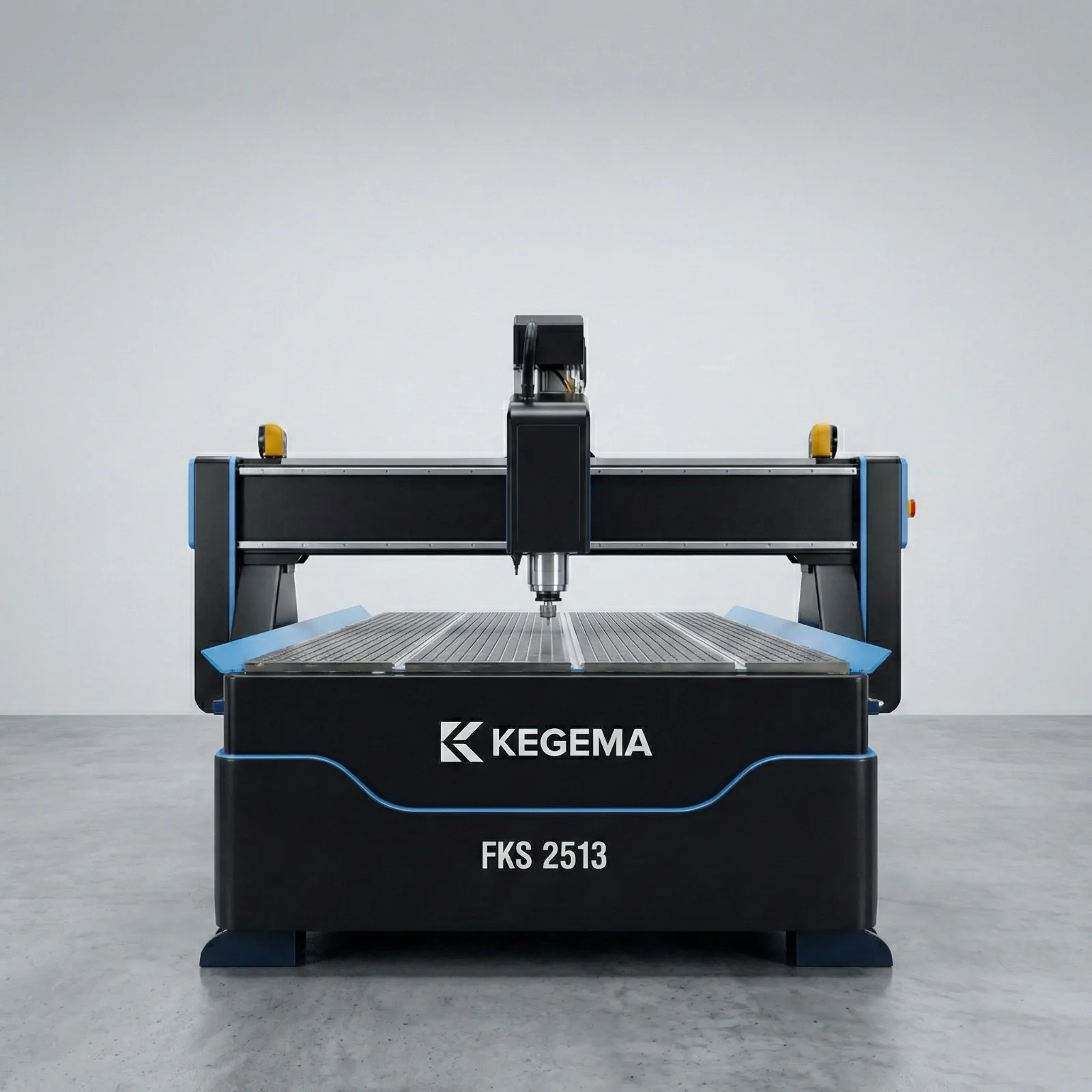
The Kegema KGL series offers state-of-the-art laser technology for the highest cutting speeds and burr-free edges. Optimised for the machining of metals and plastics in industrial manufacturing.
- State-of-the-art fibre laser technology
- Positioning accuracy ± 0.03 mm / 1000 mm
- Tube-welded machine body, gantry milled and stress relieved
- Intuitive software control for CAD/CAM workflows
What are the specifications of the Kegema KGL-3015?
Technical data for industrial laser systems
The Kegema KGL-3015 is a fibre laser cutting system with a 3000 × 1500 mm working area and a 6 kW Raycus laser source. Maximum linkage speed is 105 m/min at 1.0 G acceleration, positioning accuracy is ± 0.03 mm per 1000 mm. Beam and gantry are made from aviation aluminium.
| Model | Kegema KGL-3015 |
|---|---|
| Working area | 3000 × 1500 mm |
| Laser type | Fibre laser |
| Laser source | Raycus 6 kW (CE) |
| Laser head | BS 06K 12K |
| Control & software | XC3000S |
| Transmission | Gantry double-drive structure |
| X axis | 850 W Delta servo |
| Y axis | 2 × 850 W Delta servo |
| Z axis | 400 W Delta servo |
| Reducer | Japan Shimpo / France Motoreducer |
| Guide rails | KINGTEC / PEK, LEITESEN rack |
| Beam & gantry | Aviation aluminium |
| Max. linkage speed | 105 m/min |
| Max. acceleration | 1.0 G |
| Positioning accuracy | ± 0.03 mm / 1000 mm |
| Repositioning accuracy | ± 0.02 mm / 1000 mm |
| Machine body | Tube welded, gantry milled, stress relieved |
| Lubrication | Fully automatic |
| Electronic components | Schneider |
| Cooling | Hanli water chiller, air conditioner included |
| Exhaust fan | 5.5 kW |
| Graphic formats | CAD, DXF and others |
| Total power | 27.6 kW |
| Machine size | 5130 × 2250 × 2040 mm |
| Gross weight | 4500 kg |
| Working environment | 0 – 40 °C, ≤ 80 % humidity, no condensation |
Which Kegema fiber laser cutting machines are available?
Kegema offers the fiber laser cutting machines in two versions. The KGL-3015 has a 3000 × 1500 mm working area and a 6 kW Raycus laser source. The BKGL3015 Singletable has a 3050 × 1530 mm working area and a 3000 W Raycus source. Both are gantry machines with dual drive and reach an acceleration of 1.0 G. They differ in laser power, controller, cutting head, footprint and weight.
| Working area | KGL-3015: 3000 × 1500 mm · BKGL3015: 3050 × 1530 mm |
|---|---|
| Laser source | KGL-3015: Raycus 6 kW (CE) · BKGL3015: Raycus 3000 W (CE) |
| Controller | KGL-3015: XC3000S · BKGL3015: FSCUT2000E |
| Cutting head | KGL-3015: BS 06K 12K · BKGL3015: BOCI BLT310 with autofocus |
| Max. speed | KGL-3015: 105 m/min · BKGL3015: 100 m/min |
| Servo drives | KGL-3015: Delta, 850 W (X), 2 × 850 W (Y), 400 W (Z) · BKGL3015: Schneider, 2 × 850 W + 750 W + 450 W (with brake) |
| Machine dimensions | KGL-3015: 5130 × 2250 × 2040 mm · BKGL3015: 4370 × 2250 × 2000 mm |
| Gross weight | KGL-3015: 4500 kg · BKGL3015: 2500 kg |
At 4370 mm in length and 2500 kg gross weight, the BKGL3015 is the smaller of the two and easier to place in a shop with limited floor area or limited floor loading. The KGL-3015 offers the higher laser power and the slightly faster traverse rate.
Which materials and sheet thicknesses does a 3000 W fiber laser cut?
For the BKGL3015 with the 3000 W Raycus source, the manufacturer states cutting thicknesses per material. Carbon steel can be cut thickest, aluminium and brass considerably thinner. These figures are maximum values: the manufacturer notes that the usual production cutting thickness is 1 mm below the stated maximum.
| Carbon steel | ≤ 22 mm |
|---|---|
| Stainless steel | ≤ 10 mm |
| Galvanised sheet | ≤ 10 mm |
| Aluminium | ≤ 8 mm |
| Brass | ≤ 6 mm |
No manufacturer cutting-thickness data is available for the KGL-3015 with its 6 kW source. Higher laser power cannot be converted into specific millimetre figures without a datasheet, so we do not quote any here.
The format limit follows from the working area: sheets up to 3000 × 1500 mm on the KGL-3015 and up to 3050 × 1530 mm on the BKGL3015. Larger sheets, tube and profile cutting, and materials not listed above are outside the scope of these configurations. In those cases a sample cut before ordering is more reliable than extrapolating from the datasheet.
How accurate is a KGL series laser cutting machine?
According to the manufacturer, both the KGL-3015 and the BKGL3015 achieve a positioning accuracy of ± 0.03 mm per 1000 mm and a repeatability of 0.02 mm. These figures describe axis movement, not kerf width. Actual edge quality also depends on material, thickness, assist gas and nozzle condition.
Those figures rest on the mechanics. The KGL-3015 machine body is tube-welded, gantry-milled and stress-relief annealed; the BKGL3015 has a heavy welded, heat-treated machine bed. Both machines use a dual gantry drive, meaning the crossbeam is driven on both sides rather than pushed from one end. On the KGL-3015 the axes run on KINGTEC/PEK guideways with LEITESEN racks, and gantry and crossbeam are made of aircraft aluminium. Fully automatic lubrication feeds the guideways on both machines, so maintenance does not depend on manual greasing intervals.
Which components are built into the Kegema laser machines?
The BKGL3015 combines a 3000 W Raycus fiber laser source (CE), an FSCUT2000E controller and a BOCI BLT310 cutting head with autofocus. The KGL-3015 runs a 6 kW Raycus source, an XC3000S controller and a BS 06K 12K laser head.
- Drives: BKGL3015 with Schneider servo motors 2 × 850 W, 750 W and 450 W (with brake), Shimpo gearboxes. KGL-3015 with Delta servos and gearboxes from Shimpo and France Motoreducer.
- Electrical components: Chint on the BKGL3015, Schneider on the KGL-3015.
- Cooling: Hanli-3000-QG2/2 water chiller on the BKGL3015, Hanli water chiller plus air conditioning on the KGL-3015.
- Pneumatics: proportional valve and solenoid valve from SMC.
- Operation and monitoring: industrial PC with PAD monitor, assist-gas low-pressure alarm and remote control on the BKGL3015.
Having the actual makes listed in the datasheet matters for costing: spare parts sourcing, operator training and service access all depend on the specific controller and cutting head. On machines whose datasheet says only "fiber laser source", none of this can be checked before purchase.
What power supply and floor space does the laser cutting machine need?
The BKGL3015 connects to a 3-phase supply of 380 V ± 10 % at 50/60 Hz. For the KGL-3015 the manufacturer states a total connected load of 27.6 kW. Beyond the machine itself, the ancillary units need floor space and power, which belongs in the installation planning.
| Power supply BKGL3015 | 3P 380 V ± 10 %, 50/60 Hz |
|---|---|
| Total connected load KGL-3015 | 27.6 kW |
| Machine dimensions KGL-3015 | 5130 × 2250 × 2040 mm |
| Machine dimensions BKGL3015 | 4370 × 2250 × 2000 mm |
| Weight KGL-3015 | 4500 kg gross |
| Weight BKGL3015 | 1650 kg net, 2500 kg gross |
| Compressor BKGL3015 | 15 kW, 16 bar |
| Voltage stabiliser BKGL3015 | 40 kVA |
| Fume extraction KGL-3015 | 5.5 kW |
| Operating environment | 0 to 40 °C, ≤ 80 % humidity, non-condensing |
Before delivery, clarify access route and floor loading for up to 4500 kg, a clear height above 2040 mm, the three-phase connection, and where the compressor, voltage stabiliser and extraction unit will stand. The operating limits of 0 to 40 °C and a maximum of 80 % relative humidity without condensation are the planning figures for unheated halls.
What is included in the delivery and what warranty applies?
According to the manufacturer, the BKGL3015 ships with an extraction fan, safety goggles, a remote control, an industrial PC with PAD monitor, an assist-gas low-pressure alarm, a compressor rated 15 kW at 16 bar, a 40 kVA voltage stabiliser, the Hanli-3000-QG2/2 water chiller and automatic lubrication. The KGL-3015 includes air conditioning, a Hanli water chiller and a 5.5 kW extraction unit.
The warranty is split: 2 years on the laser source and 1 year on the machine. Wear parts are excluded, specifically lenses, mirrors and nozzles. These are consumables replaced at the end of their service life, so their cost belongs in the running cost calculation rather than in the warranty assessment.
The BKGL3015 assist-gas low-pressure alarm signals a drop in gas pressure. That matters in production because cuts made at insufficient assist-gas pressure can become unusable before the fault is noticed on the part.